Process vs outcome visualisation: picture the path, not just the finish line
Why picturing the steps to a goal can help more than picturing the result, what the research found, and a short process visualisation you can try today.
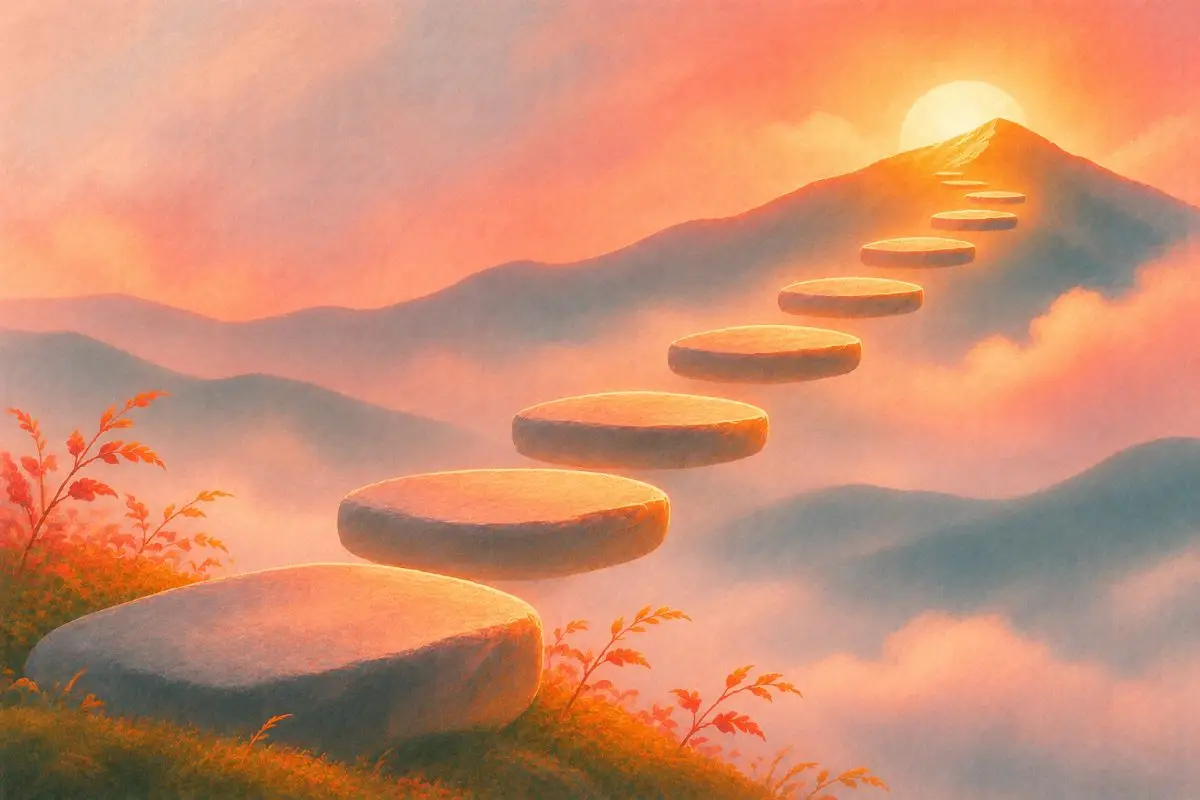
Most visualisation advice says: picture your goal as if it’s already happened. See the acceptance letter, the full bank account, the stage. It feels wonderful. Then, often, nothing changes.
There’s a reason, and a simple fix.
Two kinds of visualisation
Outcome visualisation pictures the result. You, holding the offer letter.
Process visualisation rehearses the path. You, opening the laptop on Monday morning, writing the first paragraph of the cover letter, pressing send.
What the research found
Lien Pham and Shelley Taylor (1999) asked students preparing for an exam to spend a few minutes a day visualising. One group pictured getting a high grade. Another pictured how they would study: where, when, what they’d do. The process group started studying earlier, studied more, and did better on the exam.
Other work points the same way. Gabriele Oettingen’s lab found that positive fantasies about an ideal future can lower the energy you bring to pursuing it (Kappes & Oettingen, 2011). The good feeling arrives early, as if the goal were already reached.
None of this says the outcome picture is useless. It gives you the why. It just shouldn’t be the whole practice.
A five-minute process visualisation
- Settle (30 seconds). A few slow breaths, longer out than in.
- The why (30 seconds). Picture the outcome briefly, and notice why it matters to you.
- The next step (2 minutes). Picture the very next concrete action. Where are you? What time is it? What do you do first? See yourself doing it, slowly, once through.
- The snag (1 minute). Picture the moment you’d usually stall. See yourself meeting it: one breath, and the first two minutes anyway.
- Then the next one (30 seconds). And the step after that. One at a time.
- One action (30 seconds). Decide one small thing to do today.
That’s close to how Arya guides step-by-step visualisation, with the scene built from your own words.
Where manifestation fits
Many manifestation practices are outcome visualisation: SATS, scripting, vision boards. You can keep them. Add a process beat: after the scene, ask what’s the next step, and when will I take it? Arya’s vision board gives every picture a next step for exactly this reason, and WOOP builds the obstacle into the visualisation.
In short
Picture the finish line for a few seconds, for the feeling and the why. Spend the rest of the time rehearsing the next step and the moment you’d usually stop. Then go and do the first part.
Methods in this article
- Step-by-step visualisation Research-backed
- WOOP Research-backed
- Future-self scripting Research-backed
- Vision board with steps Manifestation ritual
References
- Pham, L. B., & Taylor, S. E. (1999). From thought to action: Effects of process- versus outcome-based mental simulations on performance. Personality and Social Psychology Bulletin, 25(2), 250-260.
- Taylor, S. E., Pham, L. B., Rivkin, I. D., & Armor, D. A. (1998). Harnessing the imagination: Mental simulation, self-regulation, and coping. American Psychologist, 53(4), 429-439.
- Kappes, H. B., & Oettingen, G. (2011). Positive fantasies about idealized futures sap energy. Journal of Experimental Social Psychology, 47(4), 719-729.
Written by the Arya team from the cited sources. For general information, not medical, psychological or financial advice.